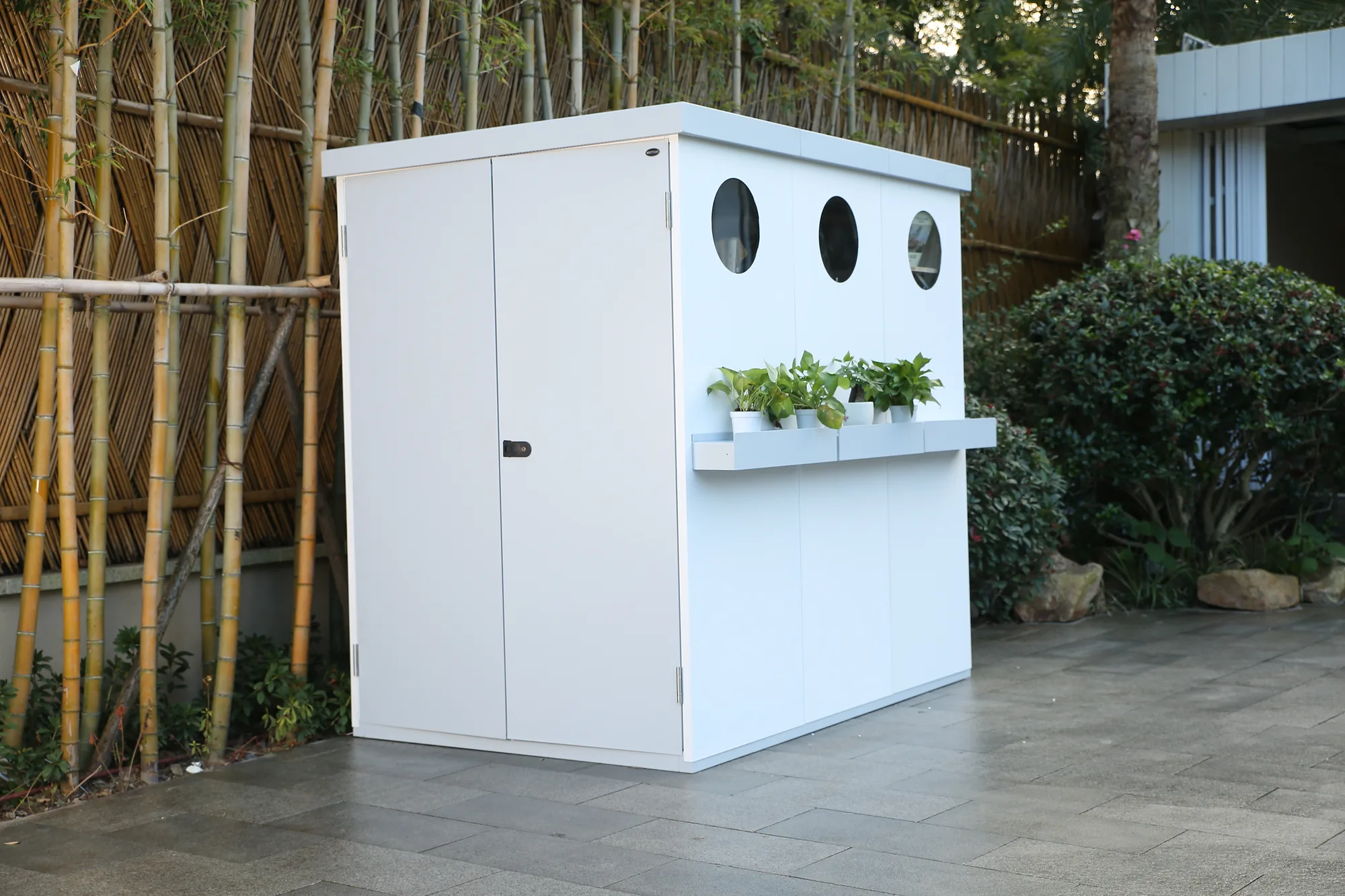
A villa courtyard accumulates things that do not belong indoors: bicycles, a lawnmower, long-handled tools, bags of compost, the inflatable pool that is used twice a year. Left out, they fade, rust and disappear under a tarpaulin. Put into a thin garden box, they stay damp and the box itself starts to fail after two seasons.
Our domestic tool-room programme was built for exactly this brief — storage that is large enough for bikes and garden equipment, dry enough for tools, and strong enough to stay put in a storm. The same requirements apply to export markets with a wet winter or a coastal climate.
Size follows the bicycle
Bicycles set the footprint. A single adult bike needs roughly 1.8 m of length and 0.6 m of width, plus room to wheel it in and out. Two bikes plus a shelf of tools usually points to a unit around 2 m wide and 1.2–1.5 m deep, with a door opening that clears the handlebars. If the courtyard also stores a mower, add a dedicated floor zone rather than stacking it against the panels.
This is why a tool room is not simply a scaled-up cabinet. The internal layout has to be planned around wheels, handles and the turning circle of a person carrying something awkward.
Waterproofing that survives real rain
“Waterproof” is easy to print on a brochure. In our testing we run the assembled unit under simulated heavy rain — around 100 mm per hour — and check the interior afterwards. The details that make the difference are unglamorous:
- Sealed panel joints and a roof that overhangs the door.
- A raised base rail, so water running across the patio does not sit against the bottom panel.
- Gutters or a drainage path that takes roof runoff away from the walls.
- Ventilation that lets damp air out without letting driven rain in.
A bicycle stored in a damp box is worse off than one stored under a breathable cover: the chain rusts, the brake cables stiffen and the saddle never dries. Keeping the interior dry is the whole point.
Wind, hail and the base
Courtyard structures are exposed. A metal tool room should be anchored to a concrete pad or a paved base, not to grass, and the anchor specification should match the local wind load. Our domestic installations have gone through typhoon seasons in coastal provinces; the units that survived were the ones with a proper base and fixed anchors, not the ones that were simply heavy.
Hail is a different load. A reinforced roof panel and a structure that distributes impact across the frame matter more than panel thickness alone. Where hail is frequent, we recommend a roof with a slight pitch and a full-perimeter fixing schedule.
What a real installation looks like
One of our domestic customers is a keen cyclist and gardener whose courtyard was permanently crowded with equipment. Before the tool room, rain meant wet bikes and wet tools; after it, both stayed dry through the monsoon and the unit came through a hail event with only light marks on the roof. That is a modest outcome to describe, but it is the outcome buyers actually want: nothing dramatic, nothing damaged.
Specification checklist for buyers
- Internal length that clears the longest bike, plus door swing.
- Galvanised steel with a powder coat suited to the local climate.
- Sealed joints, raised base and roof overhang.
- Anchoring rated for the site’s wind load.
- Ventilation that does not compromise rain protection.
- Flat-pack packaging that protects panels in transit.
Our garden sheds and tool stores are built to this brief. If you are specifying for a coastal or storm-prone market, send us the wind load and the intended contents and we will recommend the right model and anchoring package.