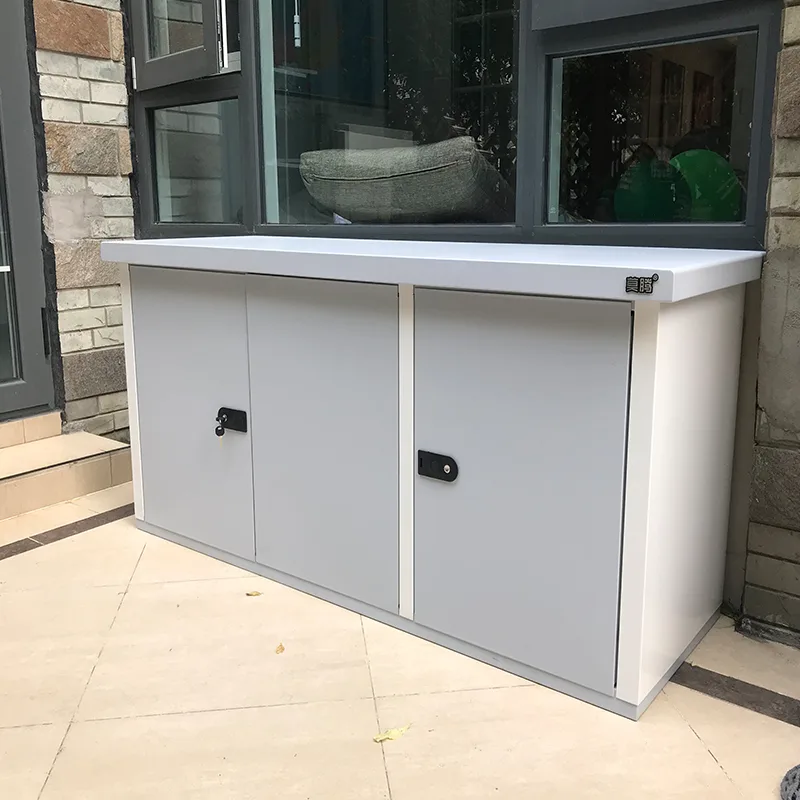
Modular construction is what allows an outdoor cabinet to fit an awkward balcony, a courtyard corner or a run of identical units for a project. Panels are formed, finished and packed flat, then assembled on site. The commercial case is strong: dense packing, lower freight per unit and the ability to offer custom sizes without new tooling.
The engineering case is harder. Every joint between two panels is a potential leak, and every leak is a warranty claim. This is how we build a modular cabinet that stays dry.
1. The gasket is the product
Between adjacent roof panels, and between the roof and the wall panels, we use an EPDM gasket — the same family of material used for car door and window seals. It is chosen for two reasons: it compresses permanently without taking a set, and it resists UV and ozone far better than a cheap foam strip. A gasket that hardens in the first summer will leak in the second winter.
The gasket is only effective if the panel edges are formed to hold it in place. A flat overlap relies on the fixing pressure alone; a formed channel keeps the seal located even when the panels expand and contract in the sun.
2. Silicone as a second line of defence
After the roof is fitted, the installer can run a bead of silicone over the joints as a secondary seal. We supply the silicone and a applicator in the accessory pack, so the buyer is not left to source a compatible sealant locally. This is deliberately a belt-and-braces approach: the gasket does the work, the silicone covers site variation and minor handling damage.
3. A roof that drains
Large-depth cabinets use a pitched roof with a 50 mm fall from front to back. That slope is not cosmetic. Standing water on a flat roof finds every fastener and every imperfect joint; a fall moves it to the edge and off the unit. Combined with a small overhang, it keeps water away from the door line, which is where most leaks begin.
4. Assembly with one tool
The cabinet is assembled on site with a single power screwdriver. The sequence is deliberately short: base frame, corner posts, wall panels, roof beams, roof panels, door and hardware, shelves, then the finishing covers. No welding, no specialist labour, no site cutting. A printed manual is included, and the fixing bag is labelled by step.
For a distributor, this matters twice. It keeps installation simple for the end customer, and it means a project order can be installed by a small team without a factory engineer on site.
5. The structure behind the panels
The panels are not the structure on their own. Loads are carried by a frame of posts and rails, with the panels acting as the skin. The specification for our modular range includes:
- Substrate: galvanised steel sheet (SGCC), 1.0 mm or thicker.
- Finish: precision sheet-metal forming with an automotive-style paint system.
- Seismic: designed to a seismic intensity of 9.
- Wind: hurricane resistance to level 5 — sustained wind of 70 m/s, with the structure tested to 88 m/s.
- Fire: exterior wall Class A, interior wall and floor Class B1, fire resistance 2.5 hours (Class II).
- Snow: 1.5 m snow load; roof capacity 200 kg/m².
- Emissions: E0 formaldehyde.
These are structural figures, not marketing language. They are the reason a modular cabinet can be specified for a public project as well as a garden.
What this means for importers
A modular system gives you a product family rather than a single SKU: the same panels and extrusions produce a narrow balcony cabinet, a deep tool store and a walk-in unit. You can quote custom sizes without new tooling, ship them flat, and support them with one assembly method. The engineering work is in the joints — and that is where a cheap modular cabinet and a durable one separate.
If you are evaluating a modular supplier, ask for the gasket material, the roof fall and the fixing schedule. The answers tell you more than the panel thickness on its own.